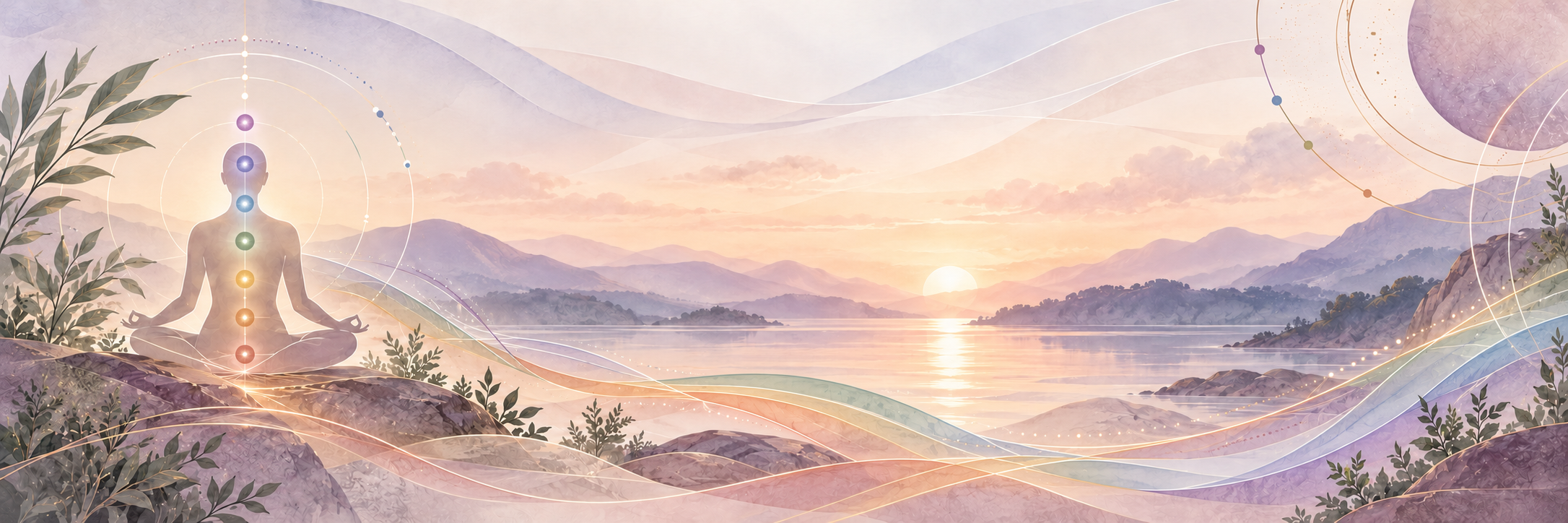
Welcome to Your Nervous System Regulation Journey
Mind • Body • Soul | A 7-Step Journey to Greater Awareness, Balance & Resilience
Your nervous system influences how you experience stress, respond to challenges, connect with others, and move through everyday life.
When life feels overwhelming, it's easy to get caught in familiar patterns of tension, worry, reactivity, or disconnection. These responses are often automatic, shaped by our past experiences, habits, and the ways our nervous system has learned to protect us.
The good news? With awareness, understanding, and consistent practice, we can begin to develop new ways of responding.
This self-paced program is designed to help you better understand yourself, recognize your body's signals, release accumulated tension, and develop practical tools to support nervous system regulation, emotional awareness, and resilience.
Through yoga, mindful movement, breathwork, meditation, relaxation, and nervous system education, you'll explore the connection between your mind, body, and emotional wellbeing.
The goal isn't to eliminate stress or feel calm all the time. It's to build your capacity to navigate life's ups and downs with greater awareness, flexibility, self-compassion, and choice.
Your 7-Step Journey
Your journey unfolds through seven interconnected stages of awareness and personal growth:
NOTICE → GROUND → FEEL → RESPOND → EXPAND → EXPRESS & CHOOSE → INTEGRATE
Each stage builds upon the previous one, inviting you to deepen your understanding of yourself while developing practical skills you can carry into everyday life.
Inspired by the traditional chakra system, each stage also explores a different aspect of your physical, emotional, and personal wellbeing. The chakras are used as a symbolic framework for self-reflection, while the practices draw upon principles of movement, mindfulness, stress physiology, and nervous system regulation.
How to Use Your Program
This is your journey, and there is no perfect way to move through it.
Each of the seven stages includes four guided yoga experiences:
MIND | 15-Minute Hatha Yoga: Build strength, balance, body awareness, and mindful connection through gentle, intentional movement.
BODY | 15-Minute Stretch & Mobility: Explore supportive stretching and mobility to ease tension, improve movement, and reconnect with physical sensations.
SOUL | 15-Minute Relaxation: Slow down through calming breathwork, meditation, restorative practices, and guided relaxation.
FULL EXPERIENCE | 75-Minute Mind • Body • Soul Yoga: Bring all three elements together in one complete, integrated practice.
You can choose how you'd like to practice:
Move through the seven stages in order for a progressive experience, or return to individual practices whenever you need additional support.
Short on time? Choose a 15-minute practice.
Have more space in your day? Enjoy the full 75-minute experience.
You can repeat each practice as often as you like. Sometimes the greatest insights come not from doing something new, but from noticing how a familiar experience feels different each time.
Move at your own pace, modify anything that doesn't feel supportive, and remember that rest is always an option. Let your comfort, health needs, and current capacity guide your choices.
Bringing Your Practice Into Everyday Life
The real value of this journey extends beyond your yoga mat.
Throughout the program, you're invited to take small moments to pause, notice what's happening within you, and consider what might support you.
A simple practice to carry with you:
Pause → Notice → Ground → Breathe → Respond with Intention
You don't need to change everything at once. Small moments of awareness, repeated over time, can help you develop more supportive habits and greater confidence in navigating everyday challenges.
Remember, nervous system regulation isn't about controlling every feeling or avoiding discomfort.
It's about building a more compassionate relationship with yourself, expanding your capacity to experience life, and learning that you have choices in how you respond.
You don't need to become someone different. You are simply learning to listen to yourself more deeply.
The practice is learning how to return to yourself. Again and again.
Welcome to your journey. 🤍

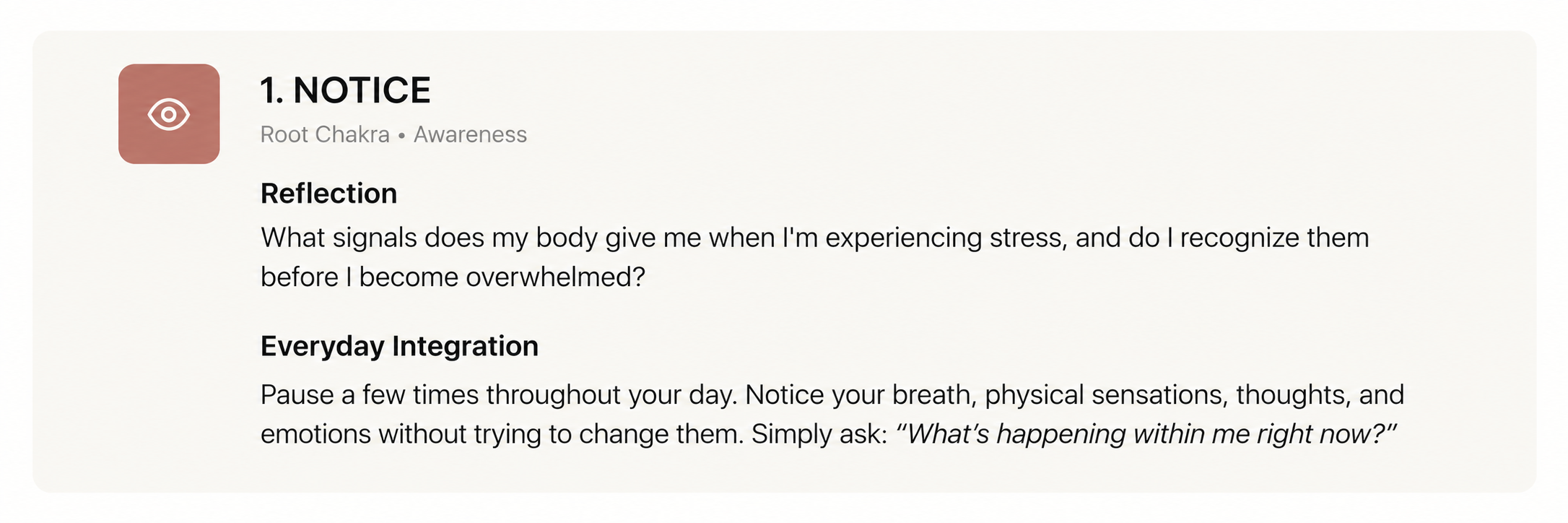
NOTICE
Awareness is where change begins.
Before we can regulate something, we first need to recognize that it is happening.
NOTICE is the foundation of the entire program. This stage is about becoming curious about your internal experience rather than automatically reacting to it.
You’ll begin observing your breath, thoughts, emotions, muscle tension, energy, physical sensations and habitual responses. You may start noticing subtle signals that previously went overlooked: a clenched jaw, shallow breathing, racing thoughts, heaviness, restlessness, fatigue or the feeling that you need to keep pushing.
The purpose is not to judge or immediately change what you discover.
It is simply to become aware.
Through mindful movement, body awareness and breathing practices, you’ll begin developing the ability to pause long enough to ask:
What am I noticing right now?
That small pause creates space between experience and reaction—and that space becomes the beginning of choice.
The practice:
Notice → Pause → Observe → Breathe
The intention:
To become more aware of yourself before automatically reacting.

GROUND
Come back to the safety of the present moment.
Once you notice that your system is activated, overwhelmed, scattered or disconnected, the next step is to reconnect with what is here now.
GROUND is about creating a sense of steadiness through the body.
Stress can pull our attention into the future, the past, our thoughts or everything happening around us. Grounding brings awareness back to physical sensation, breath, movement and the environment immediately surrounding us.
You’ll explore slower movement, supportive stretches, breath awareness and sensory practices that help bring attention out of mental overwhelm and back into your body.
Grounding does not mean forcing yourself to become calm.
It means giving your nervous system something steady to orient toward.
The feeling of your feet on the floor.
The rhythm of your breathing.
The support beneath your body.
The room around you.
This moment.
Over time, these simple anchors can become familiar ways of helping yourself reconnect when life feels like too much.
The practice:
Notice → Orient → Ground → Breathe
The intention:
To create enough steadiness to stay present with yourself.

FEEL
Listen to what your body is communicating.
Once we have enough awareness and grounding, we can begin listening more closely.
FEEL is about reconnecting with sensation, emotion and the information your body is giving you.
Many of us become skilled at overriding our internal signals. We push through fatigue, hold tension, dismiss emotions, ignore discomfort or stay busy enough that we rarely stop to ask what we actually feel.
This part of the program invites you to slow down enough to notice those messages.
Through stretching, mobility, mindful movement, breath and stillness, you’ll practice distinguishing between different sensations and observing how your internal experience changes from moment to moment.
You are not trying to analyze every feeling or turn every sensation into a problem.
You are practicing listening.
Because your body often communicates what it needs long before your mind has found the words.
The practice:
Notice → Ground → Feel → Listen
The intention:
To reconnect with your internal signals instead of automatically overriding them.

RESPOND
Move from automatic reaction toward intentional response.
Awareness becomes especially powerful when it changes what happens next.
RESPOND is about creating a small space between what you experience and how you react.
When the nervous system feels threatened, overwhelmed or under pressure, responses can become fast and automatic. We may shut down, withdraw, become irritable, overthink, people-please, rush, avoid or push ourselves harder.
These patterns are not simply “bad habits.” They are often learned ways of trying to cope, protect ourselves or get through difficult moments.
Here, you begin practicing a different question:
What would support me right now?
Sometimes the answer may be movement.
Sometimes rest.
Sometimes breathing.
Sometimes a boundary.
Sometimes connection.
Sometimes simply allowing yourself to pause.
RESPOND is where awareness begins turning into self-support.
The practice:
Notice → Ground → Feel → Respond
The intention:
To create more choice between what happens and what you do next.

EXPAND
Build your capacity without abandoning yourself.
Regulation is not about making your world smaller so that nothing ever activates you.
It is about gradually developing the capacity to experience more of life while remaining connected to yourself.
EXPAND introduces the idea that resilience can grow through gentle, manageable experiences of challenge followed by recovery.
In your yoga practices, you may explore balance, strength, longer holds, mobility or moments of mild physical effort while continuing to observe your breath and internal experience.
The goal is not to push through discomfort.
Instead, you practice staying curious:
Can I remain connected to my breath here?
Can I soften unnecessary tension?
Can I adjust instead of forcing?
Can I experience effort without interpreting it as danger?
Over time, this relationship between challenge and recovery can help strengthen confidence in your ability to move through changing experiences.
Expansion happens when we learn that we can meet more without losing connection with ourselves.
The practice:
Experience → Notice → Adjust → Recover → Expand
The intention:
To gently increase your capacity for challenge, change and everyday stress.

EXPRESS & CHOOSE
Let awareness become aligned action.
As you become more aware of what you feel and what you need, the next step is learning to honour that information.
EXPRESS & CHOOSE is where internal awareness begins shaping the way you live.
You may start recognizing when you need to speak, rest, ask for help, set a boundary, change direction, say no, say yes, slow down or move toward something that matters to you.
This does not mean always doing exactly what feels comfortable.
It means making decisions with greater awareness instead of operating entirely from habit, pressure or automatic reaction.
You’ll explore the relationship between your body, your needs, your values and your choices.
The question shifts from:
“What am I supposed to do?”
toward:
“What feels supportive, honest and aligned for me here?”
The more clearly we can hear ourselves, the more intentionally we can participate in our own lives.
The practice:
Notice → Feel → Discern → Express → Choose
The intention:
To make choices that reflect greater awareness, self-trust and intention.

INTEGRATE
Turn what you practice into how you live.
The final step is not really an ending.
INTEGRATE is about bringing everything you have practiced into ordinary life.
You will not always have an hour for yoga, meditation or relaxation—and you should not need one in order to use the skills you have developed.
Integration may look like taking one slower breath before answering someone.
Noticing your shoulders have tightened and relaxing them.
Feeling your feet on the ground during a stressful conversation.
Recognizing that you need a break before reaching complete exhaustion.
Choosing movement when you feel stagnant.
Choosing rest when your body has had enough.
Communicating a boundary.
Pausing before automatically saying yes.
Coming back to yourself after a difficult day.
The seven steps gradually become one flexible process:
NOTICE what is happening.
GROUND yourself in the present.
FEEL what your body is communicating.
RESPOND to what you need.
EXPAND your capacity over time.
EXPRESS & CHOOSE with greater intention.
INTEGRATE the practice into everyday life.
There is no expectation that you will move through this process perfectly.
Some days you may need to begin again at NOTICE.
Some moments may only require one breath.
The practice is simply learning how to return.
Again and again.
The practice:
Notice → Ground → Feel → Respond → Expand → Express & Choose → Integrate
The intention:
To make regulation less like something you “do” and more like a way of relating to yourself.